

USDT to Naira for Freelancers in Nigeria in 2026 (Real Fees and Real Numbers Compared)
Your US client just sent you $1,000 USDT on TRC20. Your rent is due on Friday. Your GTBank balance is running low. Here comes the real question: How do you turn that USDT into naira fast, cheap, and into the right Nigerian bank account?
This guide focuses specifically on USDT to naira for freelancers. Not theory, not unnecessary crypto hype. Just real arithmetic and relatable case studies. By the end of this article, you’ll know which cash-out route gives the most naira, how much $1,000 USDT becomes after fees, which network your client should use, why direct OTC conversion consistently beats double-conversion methods, and how to safely withdraw USDT into your Nigerian bank account.
Rates and fee structures referenced in this article were verified in May 2026 and should always be rechecked before transacting. The USDT to naira rate today might not be the same tomorrow.
Why Nigerian Freelancers Are Increasingly Paid in USDT Instead of USD
The regular payment structure for freelancers in Nigeria was simple a few years ago. A client from the US/UK would transfer funds via payment platforms such as Payoneer, Wise, direct bank transfer, and sometimes Paypal. Freelancers would then convert those dollars to naira via their local bank or fintech application.
Such a system still exists, but it is no longer the default method to most freelancers that work with foreign clients. In the international tech environment today, more and more Nigerian freelancers are getting paid in USDT, particularly on the TRC20 network.
This is particularly common among web designers and developers, video editors, crypto-native marketers, writers and developers working with web3 startups, employees working for foreign agencies outside the familiar banking systems, and freelance workers who collaborate with customers who are not part of the traditional banking system.
The shift happened gradually, but three big changes accelerated it up, they are:
1. International payout system’s unpredictability
In recent years, Nigerian freelancers have faced fluctuating restrictions, slow payment, failed payouts, and unreliable support from payment service providers. In the last quarter of 2022, Wise paused its USD transfers to Nigeria due to regulatory and payout challenges.
This made many freelancers who depended on Wise to seek alternatives. Same thing with Paypal whose restrictions against Nigeria users kept driving the freelancers to other payment options. On Payoneer or Grey as well, freelancers encountered FX conversion losses, withdrawal delays, banking restrictions, and intermediary bank fees.
It was also less convenient for clients, particularly small startups, to pay freelancers by these old methods. USDT addressed a lot of those issues right away.
2. Crypto settles significantly faster
The traditional method for transferring USD can be time-consuming. Automated Clearing House (ACH) network transfers can take 1-3 business days. If a weekend or intermediary bank is involved, the length of time for international bank wires can even be longer.
However, USDT operates differently. Usually, settlement occurs within minutes after a client sends USDT on TRC20. In most situations, the freelancer is paid much more quickly than by a local Nigerian bank transfer. For freelancers, that speed matters more than most people think. A designer waiting for money meant for his rent doesn’t want to hear: “The transfer is processing.” A freelancer who has to pay employees or has a short-term bill to pay wants immediate settlement.
That’s one of the reasons why cryptocurrency payroll is becoming more adopted among remote startups and Web3 businesses.
3. Clients want lower payments costs
Another critical factor that spurred the growth of USDT among freelancers is its price. Clients observed that it can cost about $20 to $50 to send $1,000 through the traditional international banking channels, after deducting intermediary bank charges and FX spreads. The TRC20 charges are approximately $1 when the same amount is sent. This difference changes the response of a client who wants to economize, with many of them realizing:
- Crypto is cheaper and faster compared to the traditional method
- Crypto is free from banking complications.
- Crypto is available worldwide without regional restrictions.
Consequently, when paying freelancers in Africa, Asia and Latin America, more international clients are turning to stablecoins as their preferred payment options. This is an entirely new Freelancer Workflow. As a result of this, the modern freelancer in Nigeria may find that he is dealing with a hybrid payment system. It is now common for freelancers to receive:
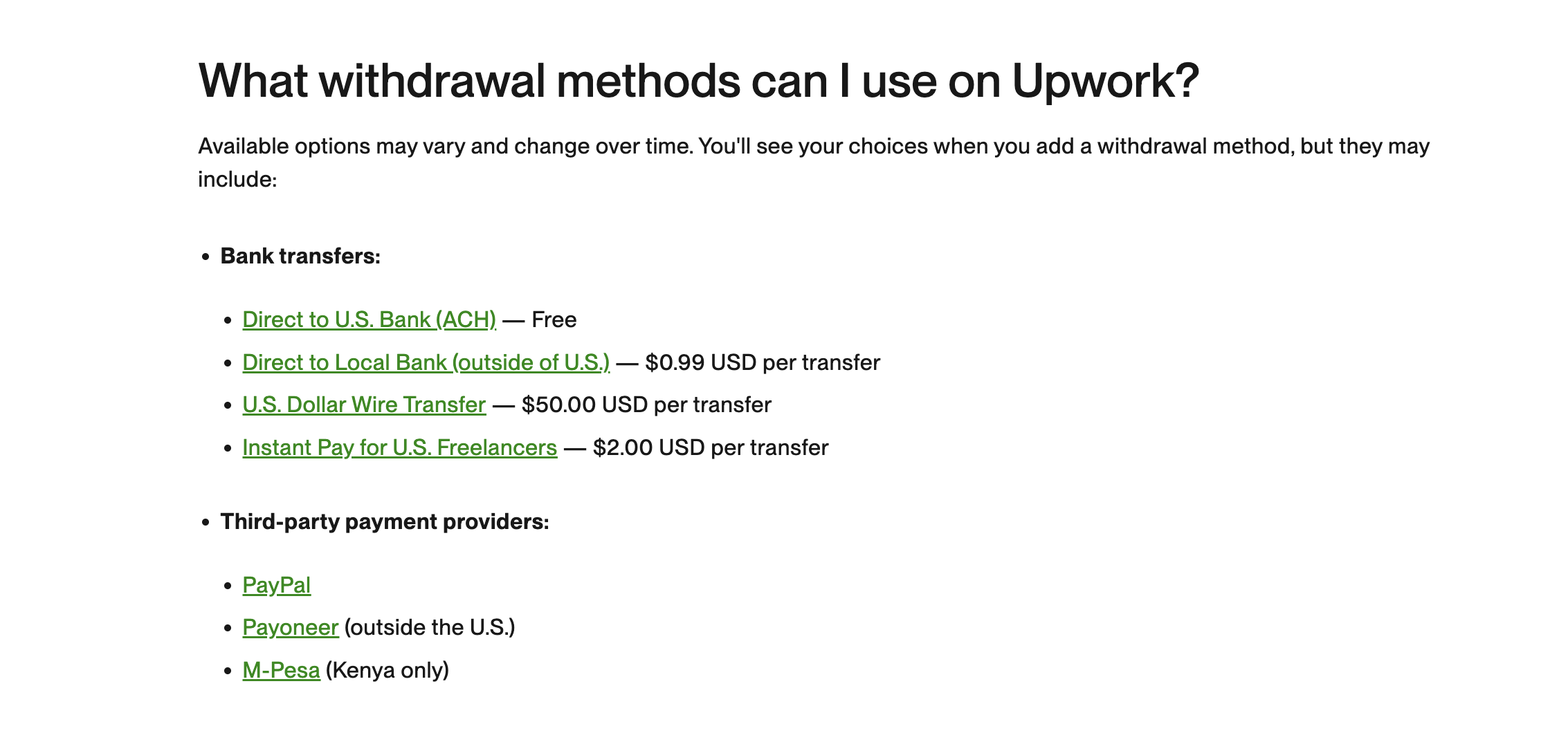
- Upwork payments using Payoneer.
- Direct USDT payments from private international clients
- Stablecoin payments from remote agencies and Web3 organizations.
- Cryptocurrency payroll of remote startups.
- Payments from agencies making USDT transfers to contractors globally
Which leaves a whole new set of issues. The foremost question a few years ago was ‘how do I receive international payments in Nigeria?’ Today, the bigger question is “How can I convert this USDT into Naira without losing a significant percentage of the conversion to fees, spreads, delays, and unnecessary conversion chains?” This is the actual challenge for modern payment guides to solve, and that is exactly what we are going to do here.
The Three Real Cash-Out Routes for Freelancer
As a freelancer there are three methods by which you can cash-out your USDT. Upon receiving USDT from the client, the real part starts. Not every cash-out procedure is the same. Some are faster, some are more comfortable, and some have a comparatively better rate. Others quietly eat your funds with multiple fees, FX spreads, delays and unnecessary conversion chains.
The truth is, most Nigerian freelancers who are getting USDT at present, are using one of three ways. Knowing how each one of them functions and where the hidden costs appear is all the difference between retaining most of your income and losing a big percentage of it every month.
Route A — Sell USDT directly via an OTC app (Dtunes, Breet, Koyn)
This method sells USDT directly via an OTC App. This is the shortest and easiest route. Freelance platforms such as Dtunes, Breet and Koyn are available to help convert USDT directly to Naira, without having to convert to USD. The following sequence of steps should be used:
- USDT is transferred to the OTC platform where it is subsequently transferred to the Nigerian bank account. This simplicity is more important than it seems at first glance. There is no intermediate USD conversion, no separate withdrawal process, absence of an international banking layer, No extra FX spread between USD & naira.
- You get USDT, sell it immediately and withdraw naira to your local bank account. For freelancers who are concerned about impressive cashout speed, minimal friction, and lower fee layers, the cleanest workflow that you can find is the OTC application. This is why many Nigerian freelancers who get stablecoin payments on a regular basis prefer the OTC cashout as their default route.
Route B — Convert USDT to USD on a fintech (Cleva, Geegpay), then withdraw to naira
The second option is a more familiar one for freelancers who are already using a fintech platform like Cleva, Grey or Geegpay. The flow is as follows:
USDT → USD wallet → naira withdrawalMany users find this route more psychologically safer as it is more similar to the traditional banking route. The freelancer does not sell crypto directly, but rather he/she first exchanges USDT for USD within a fintech environment and then later, converts to naira. But with each one of these conversions comes extra costs.
Typically, losses are due to: crypto conversion fees, FX spreads, withdrawal margins, and hidden exchange-rate differences. All of those fees are not individually large on their own. It adds up rapidly when they are combined. That loss might be a manageable one for those freelance workers who receive payments from USDT occasionally.
However, it is a significant amount when compared to freelancers earning $1,000-$5,000 every month.
Route C — Use P2P (Binance P2P, Bybit P2P, KuCoin P2P)
Peer-to-peer trading platforms are platforms such as Binance P2P, Bybit P2P, KuCoin P2P, etc. The flow looks like this:
USDT → P2P buyer → Nigerian bank transfer.This is an appealing route because sometimes the P2P rates are higher than OTC rates. On the surface, it may seem the “smartest” thing to do from a budget point of view. However, the better rate is accompanied by operational risk. You’re not dealing with someone familiar on the platform, meaning you’re dealing with a stranger whose intentions you can’t verify. You also don’t know where they’re getting their money from or whether the money is legitimate or not.
This raises some dangers such as fake payment alerts, manipulated bank screenshots, delayed transfers, escrow disputes, chargeback-related issues and banking complications that could be connected to the EFCC. P2P might still work for experienced traders if they take certain precautions.
However, for the majority of freelancers, this small rate benefit is not worth the stress and risk, especially when you’re relying on freelance work to pay your rent, bills, subscriptions and daily expenses.
1000 USDT, Three Routes, Real 2026 Fees
Let’s see the math for $1,000 worth of USDT using the three routes mentioned above and their corresponding value in Naira in 2026 Fees.
This is the part that other articles miss or don’t even attempt to put down on paper. Many guides say things like “Payoneer is expensive”, “Crypto is cheaper”, “OTC is faster”. However, very few are forthcoming with the arithmetic, which is equally very important, because when you compare the real numbers side by side, you can’t ignore the difference between these routes.
Let’s take the same starting point with all three methods, then, rather than generalities, let’s use the same starting point. Same amount. Same network. Same destination bank. This will keep the comparison fair and levelled.
Key assumptions used in all calculations:
- Amount received: 1,000 USDT
- Network: TRC20
- Estimated USDT value: ₦1,376 per USDT
At perfect market conditions, $1,000 USDT should roughly equal ₦1,376,000 which becomes our benchmark.
Route A — Sell USDT Directly on Dtunes (OTC)
| Step | Cost / Result |
| Receive 1,000 USDT on TRC20 | $1 network fee (paid by sender or deducted from amount) |
| Net received | 999 USDT |
| OTC rate (1% below mid-market assumed) | ₦1,363 per USDT |
| Conversion result | 999 × ₦1,363 = ₦1,361,637 |
| Cashback (0.5%) | +₦6,808 |
| Bank transfer | Free |
| Time | 5–10 minutes |
Final Amount Received
₦1,368,445
Approximately 99.5% of mid-market value.
Route B — Convert USDT → USD on Cleva, Then Withdraw
| Step | Cost/Result |
| Send 1,000 USDT to Cleva USD wallet | Network fee: $1 |
| Net USDT received | 999 USDT |
| Cleva conversion fee | Free (0%) |
| Net USD equivalent | $999 |
| Cleva withdrawal spread | Assume 1.75% below mid-market |
| Effective withdrawal rate | ₦1,353 per USD |
| Convert $999 to naira | 999 × ₦1,353 = ₦1,351,647 |
| Bank withdrawal | Free on most fintechs |
| Time | Same day to 1 business day |
Final Amount Received = ₦1,351,647
That is approximately 98.2% of mid-market value.
Route C — Convert USDT → USD on Payoneer, Then Withdraw
This route is where freelancers quietly lose the most money.
Payoneer does not natively accept USDT deposits. That means extra steps:
USDT → Binance → USD → Payoneer → Nigerian bankEvery step introduces:
- Trading fees
- Wire fees
- Withdrawal charges/FX spreads
| Step | Cost / Result |
| Sell USDT for USD on Binance | Trading fee: 0.1% |
| Net USD after trade | $999 |
| Withdraw USD to Payoneer | Bank wire fee: $3 |
| Net into Payoneer | $996 |
| Payoneer withdrawal fee/ FX margin | 3.5% |
| Effective USD after total fee chain | $961.14 |
| Convert to naira at ₦1,377 | ₦1,323,490 |
| Time | 2–5 business days |
FINAL NAIRA RECEIVED = ₦1,323,490 (that is about 96.2% of mid-market value)
The Verdict (comparing them side by Side)
| Route | Final ₦ Received | % of Mid-Market | Time | Loss vs Dtunes |
| Dtunes (direct USDT sell) | ₦1,368,445 | 99.5% | 5–10 min | — |
| Cleva (USDT → USD → ₦) | ₦1,351,647 | 98.2% | Same-day | −₦19,504 |
| Payoneer route | ₦1,323,490 | 96.2% | 2–5 days | −₦91,338 |
Key takeaway
For a freelancer cashing out $1,000 USDT, the direct OTC route still preserves the highest amount. Even after adjusting the fee assumptions:
- The direct OTC route still preserves the highest percentage of value
- The Cleva route still loses nearly ₦20,000 compared to direct OTC conversion, but performs better than many freelancers assume.
The Payoneer chain still loses over ₦90,000 on the same $1,000 payment. It remains the most expensive because of the combined withdrawal and FX margins. However, this is not because Payoneer is a bad product, it’s simply because Payoneer was designed for USD banking workflows, not for crypto cash-outs.
With over a year of monthly freelance payments, that difference compounds into hundreds of thousands. Eventually, over ₦1 million is lost purely to conversion and fee layering.
Which USDT Network Should Your Client Send On?
The network also matters more than most freelancers realize
| Network | Typical Fee | Speed | Best for | Notes |
| TRC20 | ~$1 | 2–5 mins | Most Nigerian freelancers | Cheap, fast and reliable. Most widely supported |
| BEP20 | $0.10–$0.50 | 3–5 mins | Binance user | Cheapest of all options. |
| ERC20 | $3–$10+ | 10–15 mins | Large transfers ($5K+) | Expensive for small payments |
| Solana | Under $0.01 | Few seconds | Crypto-native clients | Fastest option |
For most Nigerian freelancers receiving stablecoin payments, TRC20 remains the best default network for USDT transactions. It strikes the best balance between:
- low transaction cost
- fast settlement speed
- broad exchange support and
- reliable cash-out compatibility in Nigeria
Ask your client to send USDT on TRC20 unless they object. It’s the cheapest reliable network and Dtunes supports it natively.
Step-by-step Procedures on How to Sell USDT on Dtunes
We have made this guide to be as comprehensive as possible. In case you’re worried about how to convert USDT to naira in Nigeria, we’ve got you covered, follow the steps below and you’re good to go:
Step 1: Download Dtunes and sign up to the application. Verify your mobile number on the application.
Step 2: Tap “Sell USDT.” Select your preferred network (TRC20 by default).
Step 3: Copy your Dtunes generated wallet address and send it to your client, OR transfer your own USDT into it.
Step 4: After the transaction is confirmed on-chain (usually 1–3 minutes on TRC20) you will see the exact rate and amount that you will receive from Dtunes.
Step 5: Tap ‘Confirm Sale’. The naira lands in your Dtunes wallet immediately.
Step 6: Withdraw directly to your Nigerian bank account. Naira is sent to most users within 5 –10 minutes.
What About P2P? A Quick Reality Check
P2P (such as Binance P2P, Bybit P2P, etc.) can be a bit more competitive in the rates compared to the OTC platforms. However, many freelancers do not take into account the operational risk. Examples of which include:
- Fake Payment Alerts: Scammers will send fake screenshots or SMS messages to create urgency and make sellers sell their crypto hurriedly without confirming. As a freelancer, you must know how to spot fake payment alerts.
- EFCC-Related Bank Freezing: If a buyer pays you with funds connected to fraud, your account can be a part of an investigation even if you were innocent.
- Delays: It can take time to locate reliable buyers, especially in a turbulent market. Finding a verified buyer can take 30 minutes to several hours.
The additional ₦5,000 – ₦15,000 that one can make might be too risky for many freelancers. OTC apps like Dtunes eliminate counterparty risk entirely.
Is the trading of USDT Legal in Nigeria?
Yes. The Investment and Securities Act (ISA) 2025 legalizes cryptocurrency trading in Nigeria. Users are allowed to receive and sell crypto legally with the compliant platforms that abide by the law in Nigeria. Not all platforms are trustworthy, of course! Always use platforms that have verifiable company registration, clear customer support, transparent payout structure, and operational compliance awareness.
Dtunes is an example of such a platform, it has a 24/7 customer service and a hot line (+2348113372579) that is accessible at any time.Tax (The 2026 Reality for Freelancers)
The Nigeria Tax Act reforms resulted in a change in the tax environment in Nigeria. If you make a good amount of freelance income, make sure to record all of your crypto transactions. Income above ₦800,000 annually is taxable. If you earn $1,000+ per month, you are above this threshold.
Register a TIN at TaxPro Max (taxpromax.gov.ng), it’s free. Failing to register incurs ₦50,000 fines monthly. None of these changes how you cash out USDT, but it does change what you should keep records of.
Frequently Asked Questions
Which is the lowest cost of converting USDT to naira in Nigeria?
The most cost-effective method for most freelancers is to go straight to the OTC. The advantage of selling USDT directly on OTC is that it does not involve numerous conversion layers as would happen in a Payoneer or other fintech workflow. This can result in a difference of more than ₦100,000 on a $1,000 USDT cash out versus traditional conversion chains.
Which network should my client transact USDT on?
TRC20 is typically the most obvious choice for Nigerian freelancers due to its low fees and rapid confirmations. BEP20 is also cheap if both sides already use Binance-compatible wallets. ERC20 is typically for bigger transfers because they have greater Ethereum charges. Sell USDT through TRC20, you won’t regret it.
Is it possible to get USDT directly from Payoneer?
Payoneer is not a platform that natively supports USDT deposit. To get USDT to USD, you need to use another platform to exchange them, this attracts additional fees and delays before transferring them to Payoneer.
Can I receive USDT directly into Cleva, Geegpay, or Payoneer?
Cleva and Geegpay accept USDT deposits and convert internally to USD before paying out to naira. Payoneer does not natively accept USDT, you must first sell USDT for USD on an exchange like Binance, then transfer to Payoneer.
Cleva vs Crypto in Nigeria (which Is Better for Freelancers?)
Cleva is excellent for freelancers receiving traditional USD payments through ACH, Upwork, Deel, or bank transfer. But if your client already pays you in USDT, converting crypto into USD first through Cleva introduces FX spreads and conversion costs. For most freelancers receiving stablecoin payments directly, selling USDT through an OTC platform is usually faster and more cost-efficient than routing through a USD fintech workflow.
Payoneer vs USDT in Nigeria
Payoneer works well for traditional USD freelance payments, but USDT is usually faster and cheaper for direct international transfers. Many Nigerian freelancers now prefer USDT because it avoids multiple conversion fees, settles within minutes, and can be converted directly to naira through OTC platforms like Dtunes.
What are the advantages of P2P trading over OTC trading?
P2P can have a bit better prices but OTC has a lower risk as far as transacting is concerned. OTC eliminates the stress of dealing with unknown parties and eliminates the risk of fake alerts, chargebacks, and payment disputes.
What is the best USDT to naira rate for freelancers in Nigeria?
The best USDT to naira rate is typically found on OTC platforms like Dtunes, which offer rates 0.5–1.5% below mid-market with no withdrawal fees. P2P platforms occasionally offer marginally better rates but introduce significant counterparty risk. Converting through the Payoneer route typically loses 4–8% to combined fees and FX margins.
What is the time needed to convert USDT to naira?
The time for direct OTC conversion typically ranges from 5 to 10 minutes after confirmation on the blockchain. Fintech conversion routes may take same-day to 1 business day, while Payoneer-based workflows can take several business days.
Is receiving USDT from foreign clients legal in Nigeria?
Yes. Crypto payments are legal for freelancers in Nigeria when they receive them from foreign clients. The main thing to note is to use trustworthy platforms and keep proper financial records where it’s required.
Bottom Line (The Cheapest USDT-to-Naira Path)
If your client has already paid you in USDT, it’s hard not to do the math. Direct OTC sale consistently outperforms double-conversion fintech routes, Payoneer fee chains, and slower USD workflows.
On $1,000 USDT:

• Dtunes route: ₦1,368,445
• Cleva route: ₦1,351,647
• Payoneer route: ₦1,323,490
There’s a big difference. To a Nigerian freelancer getting paid in USDT regularly, selecting the wrong cash-out option can make him/her lose millions of Naira without realizing it.

Emmanuel is in the business of turning keyword research into contents that ranks and converts. He has been doing this for 5 years, focusing on clear structure, search intent, and on-page optimization. You can catch his attention with any crypto, tech, or political related discussion.